 Deutsch
AI-Designers


When the AI thinks before it answers
A new class of language model took hold in 2026: reasoning models. Instead of firing back an answer, they work a problem through step by step — usually out of sight — and only then return a result. DeepSeek-R1, the newer V4 line, and the o3 family all showed how much a model gains when it takes a moment to think.
For businesses, that sounds tempting. Finally, an AI that picks apart a tricky contract clause, traces a production fault through its logic, or justifies an architecture decision. But this thinking has a price. It costs time, it costs compute, and it costs money. Switch reasoning on everywhere and you build yourself an expensive trap. The real skill is knowing when the extra thinking is worth it.
What actually happens during the thinking
A classic language model reads your question and produces the answer straight away. A reasoning model inserts a phase in between, generating so-called reasoning tokens: a chain of thought in which it tests assumptions, jots down intermediate results, and corrects itself. You usually never see that chain. You get only the final answer — yet you pay for every single one of those thinking tokens.
Specialists call this test-time compute: work that happens the moment you ask, not during training. The harder the task, the more tokens the model burns to solve it. A good model recognises a simple summary as trivial and answers fast. A multi-step legal review, by contrast, can swallow thousands of internal tokens before the first sentence of the answer even appears.
The newer models let you steer this. DeepSeek-V4, for instance, offers several reasoning levels, from brief to thorough. So you decide not only whether the machine thinks, but how deeply.
The price of pondering
Here it gets uncomfortable. Response times of five to sixty seconds and more are normal on reasoning runs, not the exception. For a chat assistant meant to help staff in real time, that is often simply too slow. Nobody waits a minute for the answer to a routine question.
The cost hits even harder. Industry analyses suggest that reasoning tokens drive inference costs three to thirty times higher than a standard model, depending on the task. And inference — the running cost, not the training — now eats the lion’s share of GPU spend for many production teams. Push your entire query volume through a reasoning model and you burn budget exactly where a lean model would have done the same job in a fraction of the time.
The point is not that reasoning is expensive. The point is that it is expensive in the wrong place. Deep thinking for a question that needs no thinking is pure waste.
When a reasoning model pays off — and when it doesn’t
The rule of thumb is simple. Reserve the thinking for tasks where a mistake is costly and the path to the answer runs through several steps. Everywhere else, speed and cost control win.
Test-time compute is money well spent here:
- reviewing contracts and rulebooks where clauses reference each other and contradictions matter
- fault diagnosis in complex technical systems, such as root-cause analysis in a distributed software architecture
- working through financial and risk models where every intermediate step has to be right
- scientific or engineering questions with multi-step derivations
- code reviews meant to catch logic errors, not just typos
It is wasted, by contrast, on the bulk of day-to-day work:
- summarising emails and meeting notes
- translating or rewriting text
- pulling form data into a fixed JSON schema
- answering simple customer support queries
That split sounds obvious, yet in practice the line blurs fast. One and the same application fields a trivial question one minute and a brutal one the next. That is exactly where the real work begins.
Routing: the actual engineering job
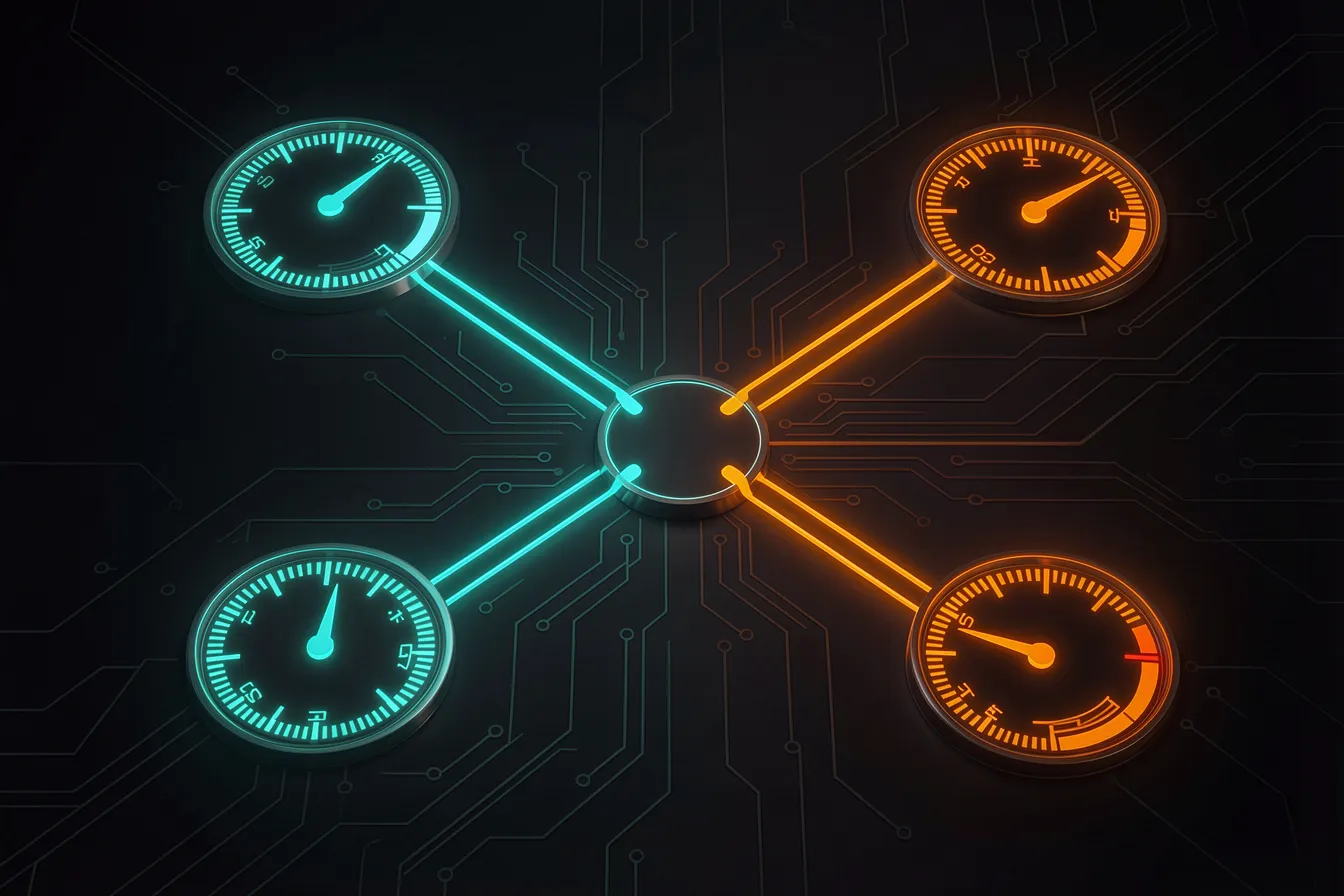
The answer is routing. A cheap classifier sits in front and inspects each request, then decides where it goes: to the fast standard model or to the brooding reasoning model. That way you pay the premium only when the task justifies it.
You may already know this pattern from model routing between small and large models. With reasoning models, a second lever comes into play: the reasoning budget. Rather than only choosing which model answers, you set a ceiling on how many thinking tokens it may spend. A mid-weight question gets a moderate budget, a genuine head-scratcher a generous one. That caps cost and latency without sacrificing quality where it counts.
In practice this means you measure. Which request types show up, how often, at what difficulty? Only once you know your query profile can you set thresholds sensibly. Routing built on gut feeling just moves the problem around.
Running reasoning in your own house
For companies with sensitive data, there is good news: the strongest reasoning models are openly available. DeepSeek-R1 and related models run on your own hardware, behind your own firewall, without a single train of thought leaving the building. The demanding tasks that make reasoning worthwhile — contracts, diagnoses, financial models — are often exactly the ones holding your most confidential information. On-premise here is no luxury; frequently it is a requirement.
The catch: reasoning models burn a lot of tokens, and a lot of tokens means a lot of GPU time. If you self-host, plan for an efficient inference server from the start, and factor in techniques like quantisation or speculative decoding. They keep ongoing operation affordable and claw back some of the time the thinking costs. The data sovereignty comes free with the deal.
More thinking isn’t automatically better
One last warning, easy to miss. Studies from 2026 show accuracy can fall again when you force a model to keep thinking past its natural token range. More compute is not a dial that turns quality up without limit. Past a certain point the model goes in circles, talks itself into a corner, or overthinks a simple matter until it breaks.
Test-time compute, then, is a knob, not a silver bullet. The gain does not come from your AI thinking more across the board, but from it thinking in the right place — and staying fast and cheap everywhere else. Casting that distinction cleanly into your own infrastructure is the job. It decides whether reasoning models become an advantage or a cost trap.
Want to bring reasoning models into your processes the right way — with routing, reasoning budgets, and secure operation on your own hardware? Talk to the team at ai-designers.eu, and we’ll work out where deep thinking actually pays off for your business.
Images: AI-Designed