 Deutsch
AI-Designers



Many companies reach for the largest available model for every AI task. That feels safe, yet it costs a lot and slows your workflows down. In 2026 a different path is emerging: instead of one giant, several small, specialized models work as a team. Each model handles exactly one job. Together they solve complex processes faster, cheaper and more transparently.
Analysts see a genuine turning point here. Gartner expects companies to use small, task-specific models three times as often as large general-purpose models by 2027. The reason is obvious: a team of five lean models runs more steadily and is easier to audit than a single prompt to a huge model.
Why a single large model is often the wrong choice
A large language model can do almost anything, but rarely anything truly efficiently. For a simple classification you fire a rocket to drive in a nail. Every request burns compute, drives up costs and lengthens response times. Across thousands of operations a day, that adds up fast.
There is also a practical problem: large models behave like a black box. When a result turns out wrong, you trace the cause only with effort. A monolithic prompt blends many sub-steps into a single call. You see the final result, but not the path to it.
Small models flip this around. They handle a clearly defined task reliably and deliver in milliseconds. If a step goes wrong, you see at once which model was responsible. That clarity saves a lot of time in operation.
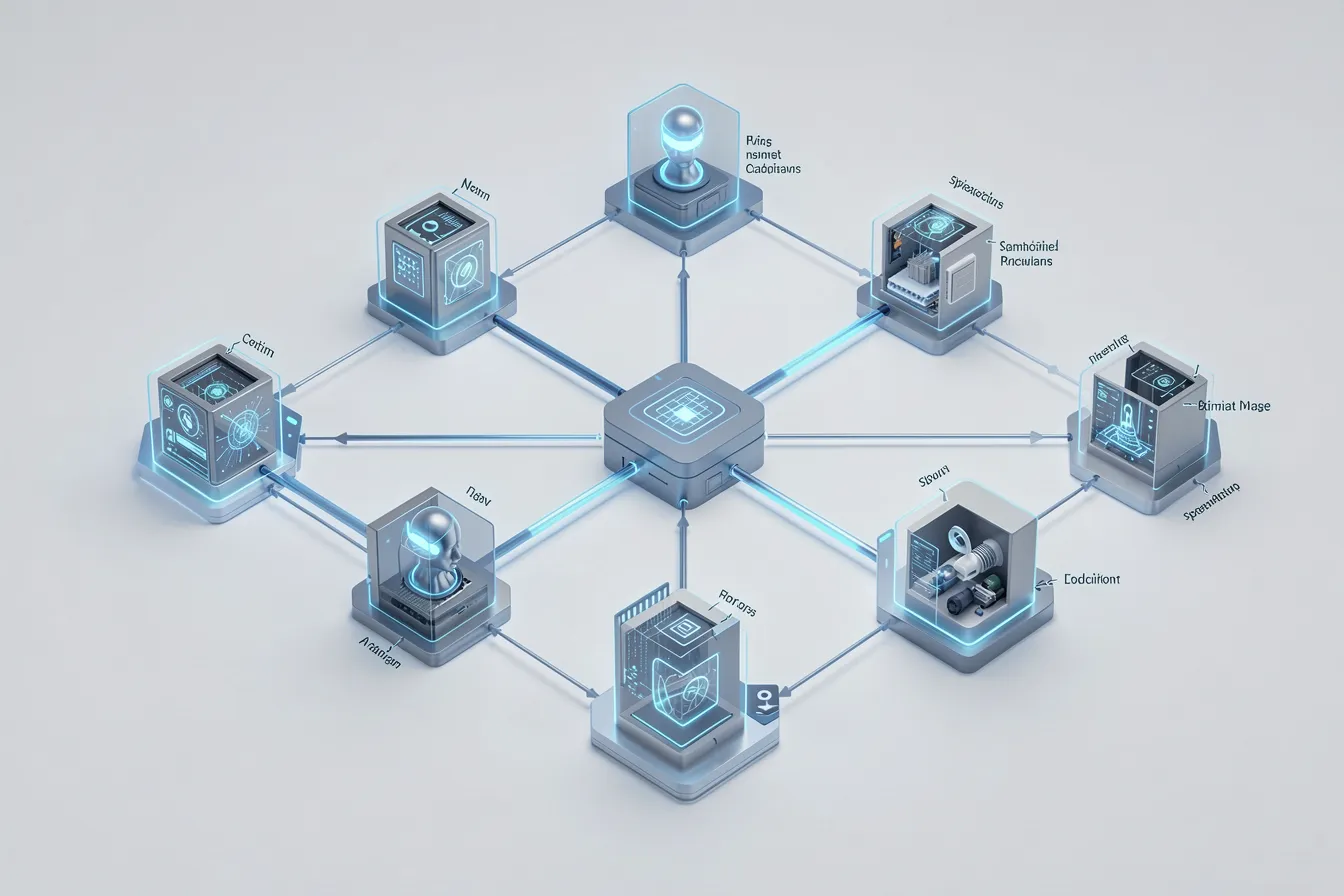
How a team of small models works together
A multi-agent system breaks a process into individual roles. One model understands the input, a second plans the steps, a third calls tools, a fourth formats the result. Each agent gets only the capabilities it truly needs. This division of labour resembles a well-drilled team in the office.
A coordinator steers the flow and passes intermediate results along. It decides which agent acts next. That creates a traceable flow instead of one opaque step. You log every handover and inspect it individually when needed.
The right models are already freely available. Companies rely on compact models with three to nine billion parameters. Such models run on ordinary server hardware, sometimes even on a single capable machine. That lowers the barrier to your own systems considerably.
Concrete use cases in the enterprise
The strength of the approach shows in everyday workflows. Wherever clear sub-steps follow one another, a model team plays to its advantages:
- Customer service: one agent identifies the request, one finds the right documents, one phrases the answer in the correct tone.
- Invoice checking: one model reads the documents, a second reconciles the amounts, a third flags anomalies for accounting.
- Sales: one agent researches a contact, one rates the potential, one drafts a fitting approach.
- Internal search: one model breaks down the question, one searches the knowledge base, one summarizes the sources clearly.
In every case the flow stays transparent. You swap out individual agents without rebuilding the whole system. When a task grows, you simply add another specialized agent.
On-premises: control over data and costs
Small models fit ideally with in-house operation. They run locally, so sensitive data never leaves the company. In regulated sectors such as finance, healthcare and public administration, this point weighs heavily. The EU AI Act reinforces this need further.

On cost, too, local operation convinces. You pay no per-request fee to an external provider. Instead you use existing hardware fully and plan your spending reliably. At high request volumes, your own infrastructure often pays off within a few months.
Add to that the independence. You decide yourself when to swap or adjust models. No provider changes behaviour or prices without warning. This planning certainty makes your AI strategy viable for the long term.
How to get started
Begin with a single, clearly bounded process. Choose a task with high volume and clear rules. Break it into sub-steps and assign each step a suitable model. That way you gather solid experience quickly.
Measure results and costs from the start. Compare the model team against your previous approach. Extend the system only once the first process runs stably. Step by step, you build a reliable and affordable AI landscape.
Want to build your own multi-agent system while keeping control over data and costs? Our team at AI-Designers guides you from the first idea to productive operation. Get in touch and start with a concrete use case.
Images: AI-Designed